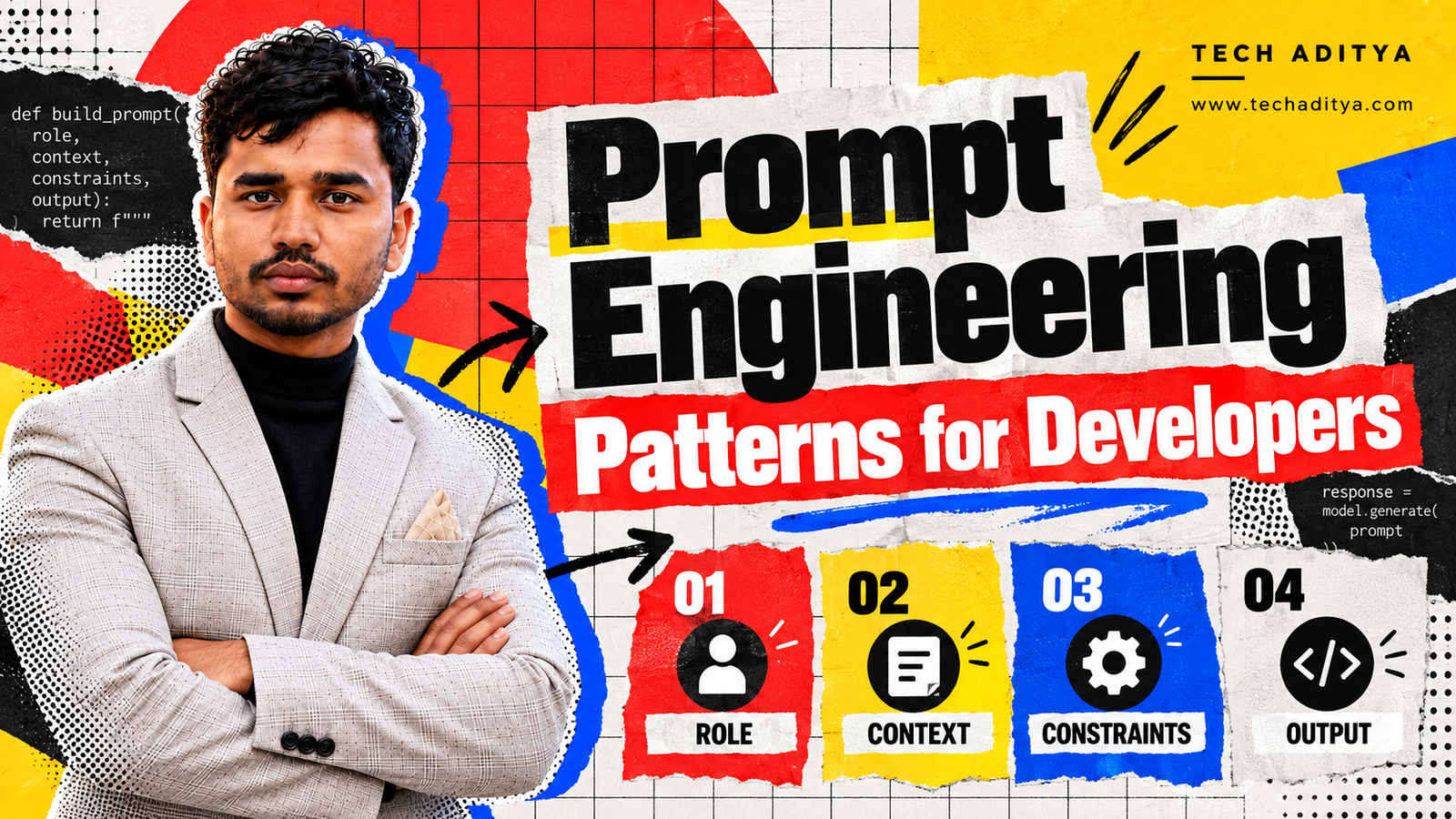
Introduction to Production Prompt Engineering
For software engineers integrating Large Language Models (LLMs) into production architectures, writing casual prompts is no longer sufficient. Relying solely on natural language requests often leads to hallucinations, flaky JSON parsing errors, and broken backend pipelines. To build robust AI-driven features, developers must treat prompts as deterministic code templates governed by strict engineering patterns.
At Tech Aditya, we engineer high-performance web applications and custom software solutions that seamlessly merge traditional backend frameworks with advanced generative AI capabilities. In this deep-dive guide, we will explore three foundational prompt engineering patterns that separate fragile chat wrappers from enterprise-ready AI microservices: Chain of Thought (CoT), Few-Shot Learning, and Strict Schema Enforcement.
Understanding Prompt Engineering Patterns vs. Casual Prompting
Casual prompting relies heavily on luck and the inherent statistical bias of the foundational model. In contrast, prompt engineering patterns structure the context window to maximize determinism and minimize parsing failures. Let us examine how these patterns compare across core architectural metrics.
| Pattern | Primary Use Case | Reliability Index | Token Overhead |
|---|---|---|---|
| Zero-Shot (Naive) | Simple text classification, casual summaries | Low | Minimal |
| Few-Shot Prompting | Domain-specific formatting, tone mirroring | Medium-High | Moderate |
| Chain of Thought (CoT) | Complex logic, calculations, code auditing | High | High |
| Strict Schema Enforcement | API payloads, database insertions, UI rendering | Maximum | Low-Moderate |
Pattern 1: Chain of Thought (CoT) Reasoning
When asking an LLM to evaluate complex business logic or debug software code in a single step, the model often jumps to conclusions, resulting in logical fallacies. Chain of Thought prompting solves this by instructing the model to generate intermediate reasoning steps before emitting the final answer.
Implementing CoT in Node.js / TypeScript
Below is a production-grade TypeScript snippet using the official OpenAI SDK to implement a robust CoT prompt for financial transaction categorization and risk scoring.
import OpenAI from 'openai';

const openai = new OpenAI({
  apiKey: process.env.OPENAI_API_KEY,
});

async function analyzeTransactionRisk(transactionData: string): Promise<string> {
  const prompt = `
    You are an enterprise financial fraud detection auditor.
    Analyze the following transaction and determine its risk level.

    To ensure accuracy, follow this exact reasoning process:
    1. Evaluate the transaction amount against historical velocity limits.
    2. Cross-reference the IP geolocation with the user\'s billing country.
    3. Check for known high-risk merchant category codes (MCC).
    4. Synthesize your findings into a final risk score (Low, Medium, High).

    Transaction Data:
    ${transactionData}

    Format your response with the following sections:
    - [REASONING]: Step-by-step audit trail.
    - [RISK_LEVEL]: Final classification.
  `;

  const resp openai.chat.completions.create({
    model: 'gpt-4o',
    messages: [{ role: 'user', content: prompt }],
    temperature: 0.1,
  });

  return response.choices[0].message.content || '';
}
Pro-Tip: Always keep the
temperatureparameter low (between 0.0 and 0.2) when utilizing Chain of Thought patterns. High temperatures introduce randomness into the reasoning steps, undermining the deterministic benefits of CoT.
Pattern 2: Few-Shot In-Context Learning
Few-shot prompting provides concrete examples of inputs paired with expected outputs directly inside the prompt context. This approach is invaluable when you need the model to adhere to strict domain terminology, idiosyncratic output styles, or non-standard markdown structures.
Structuring Few-Shot Contexts Cleanly
When building custom web applications with complex UI components, you may need an LLM to transform unstructured user queries into specific filter parameters. Here is how you structure a clean few-shot template:
const fewShotPrompt = `
Extract search parameters from natural language queries into the requested format.

Example 1:
Input: "Show me 3-bedroom apartments in Lucknow under 50000 INR with a balcony"
Output: {"property_type": "apartment", "bedrooms": 3, "max_price": 50000, "currency": "INR", "amenities": ["balcony"]}

Example 2:
Input: "Looking for commercial office space in Gomti Nagar over 2000 sqft"
Output: {"property_type": "commercial_office", "location": "Gomti Nagar", "min_sqft": 2000, "amenities": []}

Target Input:
Input: "Find luxury villas with swimming pools near Hazratganj"
Output:
`;
By providing explicit input-output pairs, the model immediately understands the expected JSON keys, data types, and semantic mappings without requiring fine-tuning.
Pattern 3: Strict Schema Enforcement (Structured Outputs)
Even with great prompt design, LLMs occasionally drift from required JSON structures. Missing brackets, trailing commas, or renamed keys can crash downstream API consumers. Modern enterprise development requires native schema enforcement.
Using OpenAI Structured Outputs with Zod
Instead of hoping the model returns valid JSON, we can enforce strict JSON schemas directly at the API decoding layer using Zod and OpenAI's structured output configuration.
import OpenAI from 'openai';
import { z } from 'zod';
import { zodResponseFormat } from 'openai/helpers/zod';

const openai = new OpenAI();

// Define strict schema using Zod
const SeoMetadataSchema = z.object({
  meta_title: z.string().max(60),
  meta_description: z.string().max(160),
  focus_keyword: z.string(),
  secondary_keywords: z.array(z.string()),
  reading_time_minutes: z.number(),
});

async function generateSeoMetadata(articleBody: string) {
  const completion = await openai.beta.chat.completions.parse({
    model: 'gpt-4o-2024-08-06',
    messages: [
      { role: 'system', content: 'Extract precise SEO metadata from the provided article.' },
      { role: 'user', content: articleBody },
    ],
    response_format: zodResponseFormat(SeoMetadataSchema, 'seo_metadata'),
  });

  const metadata = completion.choices[0].message.parsed;
  return metadata;
}
Caution: When using strict schema enforcement, ensure your application logic accounts for refusal flags. If a prompt violates safety guidelines, the parsed object may return null, and your code must handle that exception gracefully.
Combining Patterns for Enterprise Solutions
In real-world web architecture, these patterns are rarely used in isolation. For instance, when developing custom Laravel custom web applications or scalable Node.js microservices, you will often combine Chain of Thought reasoning with Few-Shot examples, and finalize the payload with Strict Schema Enforcement.
By chaining these techniques together, you eliminate the ambiguity of natural language processing and transform stochastic AI models into reliable, high-speed microservices. Whether you are scaling e-commerce platforms or building automated content engines, mastering these patterns ensures enterprise-grade reliability.
Ready to integrate advanced AI capabilities into your next digital product? Contact and consult with our expert engineering team at Tech Aditya today to discuss your custom software development needs.