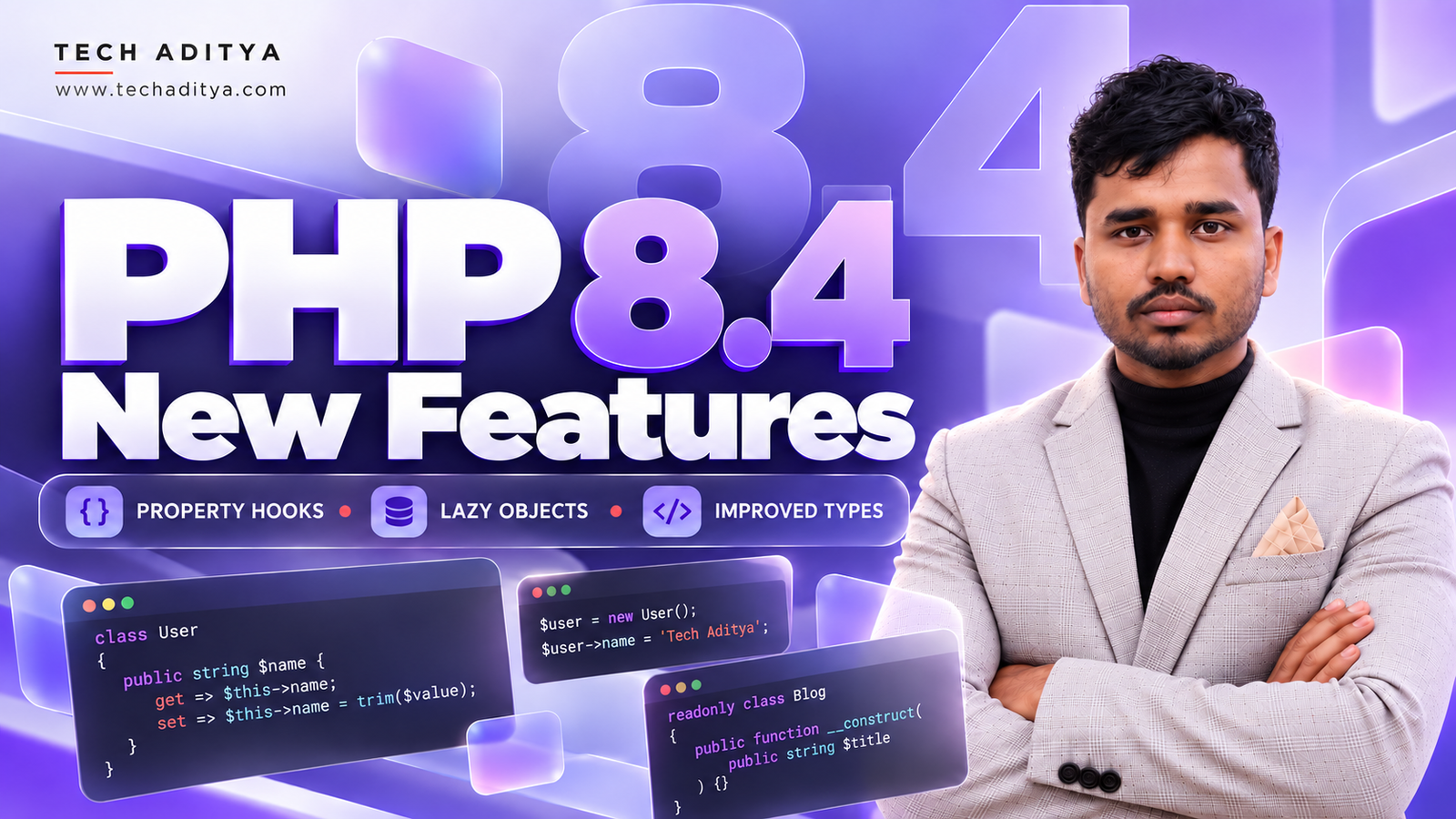
Introduction to PHP 8.4
PHP continues its remarkable modernization cadence with the release of PHP 8.4. As a premier custom web development and software engineering company at Tech Aditya, we continuously audit, test, and implement cutting-edge runtime upgrades to deliver lightning-fast applications for our enterprise and startup clients. PHP 8.4 introduces transformative syntax features like Property Hooks and Asymmetric Visibility, alongside critical JIT improvements and function additions that reduce boilerplate and enhance type safety.
In this technical deep-dive, we will explore the architectural impact of these new capabilities, provide concrete code implementations, and evaluate how they compare to older approaches.
Understanding Property Hooks in PHP 8.4
Prior to PHP 8.4, implementing custom behavior when reading or writing object properties required repetitive getter and setter methods. This approach often cluttered domain models and violated clean code aesthetics. Property hooks bring C#-style property accessors directly into PHP, allowing you to execute logic during get and set operations without exposing explicit method calls.
Implementing Get and Set Hooks
Consider a standard User entity where the user's name must always be trimmed and stored in lowercase, while being formatted with capitalized initials on retrieval. Here is how you implement this cleanly using PHP 8.4 Property Hooks:
class User {
    public string $name {
        set (string $value) => strtolower(trim($value));
        get => ucwords($this->name);
    }

    public function __construct(string $name) {
        $this->name = $name;
    }
}

$user = new User("  ADITYA KUMAR  ");
echo $user->name; // Outputs: Aditya Kumar
Pro-Tip: Property hooks can be virtual (backed by no underlying storage property if only computed values are returned) or backed by native property storage. When using hooks with backed properties, reference the property storage implicitly or explicitly depending on your implementation context.
Asymmetric Visibility: Fine-Grained Access Control
In enterprise-grade software development, encapsulation is paramount. Previously, developers had to choose a single visibility modifier (public, protected, or private) for a property. This meant if a property needed to be readable globally, it also had to be writable globally, forcing the use of read-only properties or public getters with protected setters.
PHP 8.4 introduces Asymmetric Visibility, allowing you to define a public read visibility while restricting write visibility to protected or private scopes.
Code Example: Asymmetric Visibility in Action
class Transaction {
    public private(set) float $amount;
    public private(set) string $status = 'pending';

    public function __construct(float $amount) {
        $this->amount = $amount;
    }

    public function complete(): void {
        $this->status = 'completed';
    }
}

$tx = new Transaction(1500.00);
echo $tx->amount; // Allowed: 1500.00
// $tx->amount = 2000.00; // Fatal Error: Cannot modify private(set) property Transaction::$amount
Performance Benchmarks and Architectural Comparison
When evaluating runtime upgrades, understanding the performance trade-offs is critical for high-throughput Custom Web Applications. Below is a comparative breakdown of property encapsulation strategies across PHP versions.
| Feature / Approach | Boilerplate Code | Encapsulation Level | Execution Overhead |
|---|---|---|---|
| Traditional Getters/Setters | High (Multiple methods) | Strong | Method call stack overhead |
| PHP 8.1 Readonly Properties | Low | Write-once | Zero overhead (Optimized in engine) |
| PHP 8.4 Asymmetric Visibility | Minimal | Read-public, Write-private/protected | Native property access speed |
| PHP 8.4 Property Hooks | Low | Fine-grained validation & transformation | Inline execution during access |
New Utility Functions and Ecosystem Enhancements
Beyond syntactic sugar, PHP 8.4 introduces highly requested utility functions that eliminate the need for custom userland implementations. Functions like array_find(), array_find_key(), and array_any() streamline array processing.
$orders = [
    ['id' => 101, 'status' => 'pending', 'total' => 450],
    ['id' => 102, 'status' => 'completed', 'total' => 1200],
    ['id' => 103, 'status' => 'shipped', 'total' => 850],
];

// Find the first completed order using PHP 8.4 array_find
$completedOrder = array_find($orders, fn($order) => $order['status'] === 'completed');

print_r($completedOrder);
// Output: ['id' => 102, 'status' => 'completed', 'total' => 1200]
Optimizing Web Applications for PHP 8.4
Deploying PHP 8.4 alongside modern application frameworks requires meticulous server tuning. At Tech Aditya, our engineering workflows integrate PHP 8.4 with OPcache JIT tuning and modern containerized runtimes to ensure ultra-low latency response times. Whether you are building scalable e-commerce platforms or enterprise portals, leveraging these native language features reduces memory footprints and simplifies maintenance.
To explore our complete range of architectural capabilities, visit our Web Engineering Services or Contact & Consultation page to discuss your upcoming infrastructure modernization.
Frequently Asked Questions
1. Are PHP 8.4 property hooks backward compatible with older PHP versions?
No. Property hooks and asymmetric visibility are core language syntax features introduced in PHP 8.4. Code utilizing these features cannot be executed on PHP 8.3 or earlier without transpilation or refactoring.
2. How does asymmetric visibility impact ORM hydration in frameworks like Laravel or Symfony?
Modern ORMs hydrate objects by writing to properties directly via reflection or constructors. PHP 8.4 asymmetric visibility allows reflection and internal object scope to bypass the private(set) restriction, meaning ORMs can hydrate models cleanly while keeping them immutable to external business logic.
3. What is the performance impact of using property hooks?
Property hooks execute inline byte-code equivalent to executing custom setter/getter logic, but without the overhead of a formal method dispatch stack frame. Benchmarks show negligible performance overhead while providing substantial maintainability gains.
4. How can I upgrade my production servers to PHP 8.4 securely?
We recommend auditing your existing codebase for deprecated functions, testing with PHP 8.4 RC/stable builds in a staging environment, and updating extensions (such as Redis, Imagick, and PDO) to their PHP 8.4 compatible releases before production deployment.