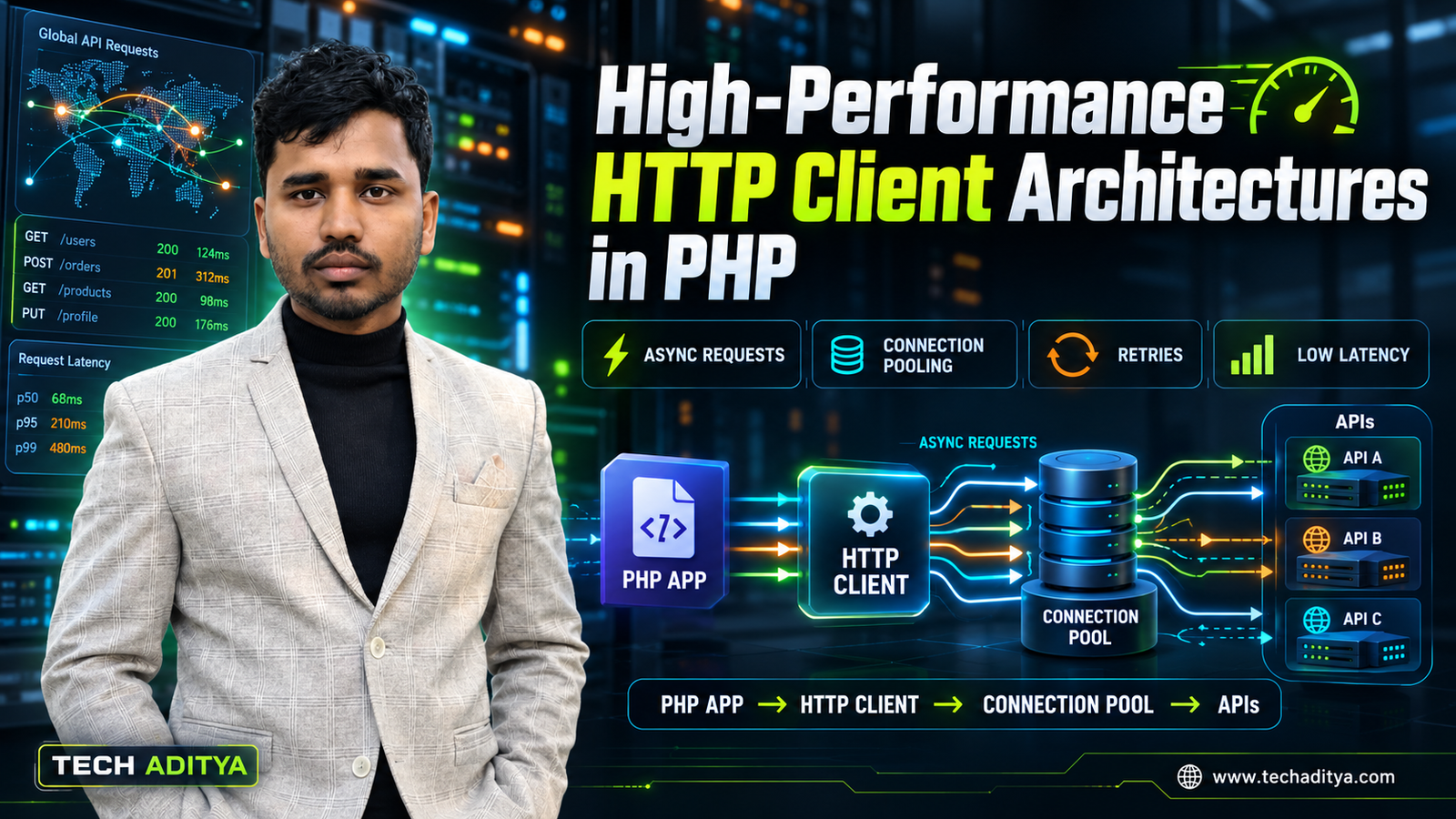
Introduction to High-Performance PHP HTTP Architectures
Modern web applications frequently rely on external APIs, microservices, and third-party SaaS platforms. Traditionally, developers instantiated a new synchronous HTTP client inside a loop, causing massive request latency bottlenecks due to head-of-line blocking and repeated TCP/TLS handshakes. At Tech Aditya, when engineering enterprise Custom Web Applications, optimizing outbound network input/output is crucial for sub-second response times.
In this comprehensive guide, we will explore how to transition from sluggish synchronous request patterns to high-throughput HTTP architectures using concurrency and connection pooling in PHP. We will inspect low-level cURL multi-handles, Symfony's lazy asynchronous scopes, and strategies for socket reuse.
The Cost of Synchronous Request Bottlenecks
When you execute serial HTTP requests using basic cURL or standard client wrappers, your application incurs a compounded latency penalty. If a single API call takes 200ms, executing five requests sequentially results in a 1000ms delay—even if the underlying network can handle them simultaneously.
Furthermore, opening a brand new TCP connection for every single request forces the operating system to perform a three-way handshake and cryptographic TLS negotiation repeatedly. Below is a architectural benchmark comparing sequential vs concurrent pooling strategies.
| Metric / Strategy | Sequential Requests (Standard) | Concurrent + Connection Pooling |
|---|---|---|
| Time for 5 API Calls (200ms each) | ~1000ms + Overhead | ~220ms Total |
| TCP/TLS Handshakes | 5 Separate Handshakes | 1 Shared Persistent Connection |
| Memory Footprint | Low per call, high duration | Optimized multiplexed buffers |
| CPU Utilization | High wait time (Blocked) | Efficient non-blocking polling |
Implementing Native Concurrency with cURL Multi-Handle
Under the hood, most high-performance PHP frameworks leverage libcurl's multi interface. This allows you to add multiple handles to a multi-stack and execute them concurrently via event loop polling.
Here is an advanced production-ready implementation of a concurrent multi-request dispatcher in PHP:
<?php

namespace App\Services;

class ConcurrentHttpClient
{
    private array $urls;

    public function __construct(array $urls)
    {
        $this->urls = $urls;
    }

    public function fetchAll(): array
    {
        $mh = curl_multi_init();
        $handles = [];

        foreach ($this->urls as $id => $url) {
            $ch = curl_init($url);
            curl_setopt($ch, CURLOPT_RETURNTRANSFER, true);
            // Enable persistent connection reuse
            curl_setopt($ch, CURLOPT_TCP_KEEPALIVE, 1);
            curl_setopt($ch, CURLOPT_TIMEOUT, 5);

            curl_multi_add_handle($mh, $ch);
            $handles[$id] = $ch;
        }

        $running = null;
        do {
            $status = curl_multi_exec($mh, $running);
            if ($running) {
                curl_multi_select($mh, 0.1);
            }
        } while ($running > 0 && $status == CURLM_OK);

        $resp
        foreach ($handles as $id => $ch) {
            $responses[$id] = [
                'body' => curl_multi_getcontent($ch),
                'status' => curl_getinfo($ch, CURLINFO_HTTP_CODE),
                'error' => curl_error($ch)
            ];
            curl_multi_remove_handle($mh, $ch);
            curl_close($ch);
        }

        curl_multi_close($mh);
        return $responses;
    }
}
Pro-Tip: Always set explicit timeouts (`CURLOPT_TIMEOUT` and `CURLOPT_CONNECTTIMEOUT`) when executing concurrent requests. Unbounded concurrent socket queues can exhaust available file descriptors on your Linux server, resulting in catastrophic `Too many open files` exceptions.
Leveraging Symfony HttpClient for Lazy Concurrency
Modern frameworks provide much cleaner abstractions. The Symfony HttpClient component uses lazy responses by default. When you send multiple requests, the client initiates them immediately in the background, but execution only blocks when you access the response payload.
Let's examine how to implement this pattern cleanly:
<?php

use Symfony\Component\HttpClient\HttpClient;

$client = HttpClient::create([
    'max_HOST_connections' => 10,
    'max_total_connections' => 100,
    'timeout' => 5,
]);

// Trigger requests concurrently (lazy evaluation)
$response1 = $client->request('GET', 'https://api.techaditya.com/v1/service-a');
$response2 = $client->request('GET', 'https://api.techaditya.com/v1/service-b');

// At this point, requests are in flight.
// We block only when processing the content.
$dataA = $response1->toArray();
$dataB = $response2->toArray();

// Both responses are safely gathered with minimal latency
Connection Pooling and Keep-Alive Mechanics
Connection pooling ensures that underlying TCP sockets remain open across different HTTP requests sent to the same domain. To achieve true pooling in PHP, your application architecture must support persistent client instances rather than instantiating a new client inside every function call.
- Singletons / Dependency Injection Containers: Register your HTTP client as a shared singleton service within your container.
- HTTP/2 Multiplexing: When communicating with modern APIs supporting HTTP/2, connection pooling is supercharged because multiple requests flow simultaneously over a single persistent TCP connection.
- Keep-Alive Headers: Ensure upstream servers return `Connection: keep-alive` headers to prevent premature socket termination.
Error Handling and Resilience in High-Throughput Scenarios
When firing dozens of concurrent requests, partial failures are inevitable. A robust HTTP client architecture must handle timeouts, DNS resolution failures, and HTTP 5xx errors gracefully without crashing the parent worker process.
Here is how you handle exceptions robustly with Symfony HttpClient:
<?php

use Symfony\Component\HttpClient\Exception\TransportExceptionInterface;

$resp
    'user' => $client->request('GET', 'https://api.techaditya.com/users/1'),
    'orders' => $client->request('GET', 'https://api.techaditya.com/orders/1')
];

foreach ($client->stream($responses) as $resp $chunk) {
    try {
        if ($chunk->isFirst()) {
            // Headers arrived
            $headers = $response->getHeaders();
        } elseif ($chunk->isLast()) {
            // Complete body received
            $c
        }
    } catch (TransportExceptionInterface $e) {
        // Log network or timeout failure safely
        error_log('HTTP Request failed: ' . $e->getMessage());
    }
}
Conclusion and Next Steps
Adopting high-performance HTTP client architectures with native concurrency and persistent connection pooling transforms sluggish PHP applications into lightning-fast, highly scalable systems. Whether you are building complex microservice orchestrators or integrating third-party logistics APIs, eliminating synchronous network lag is paramount.
Need expert assistance scaling your backend infrastructure or crafting robust Full-Stack Web Development solutions? Contact & Consultation with our engineering team at Tech Aditya today, or review our Portfolio & Case Studies to see our proven track record in high-performance web engineering.